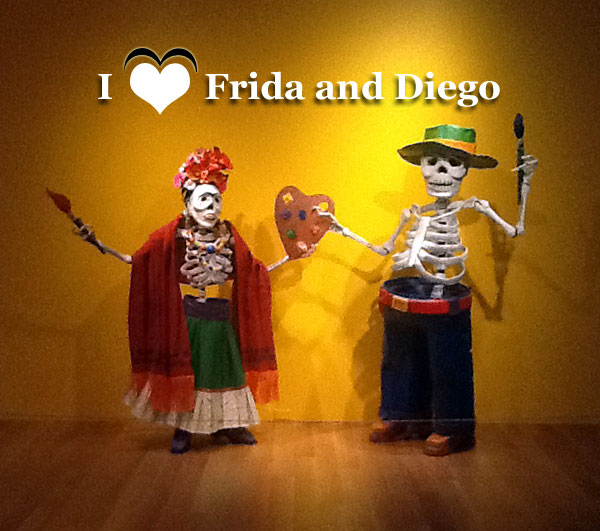
 iPad photo: Life size papier maché Mexican parade-style figures of Frida and Diego made for the show by Toronto artists Shadowland (I added the graphic title.)
Bill Byres had a spare ticket for me and we spent a couple of hours at the Art Gallery of Ontario’s Frida Kahlo and Diego Rivera exhibition today. Big show… rooms and rooms of paintings and drawings by both artists, plus many photos of the two of them. It gave us a very good look at the work history of a fascinating couple.
Diego starts off as an accomplished cubist, clearly intending to work in the framework of European avant garde art. He soon turns his talent to two main causes; socialistic revolution and Mexican peasant culture. He uses a kind of simplified, stylized, sculptural monumentalism to elevate images of his humble countrymen to heroic status. His confident, healthy ego shows up in a number of self portraits. Frida shows up in his work, too… in one case, handing rifles to worker revolutionaries.
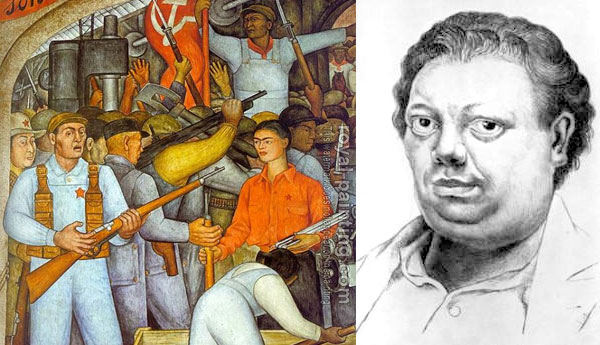
Diego was the more classically trained of the two and my guess is that he passed along technical tips to Frida, whose work leans toward folk art. Frida is most famous for her self portraits and her autobiographical, symbolic illustrations of physical and emotional suffering. She frames her story in Mexican motifs, surrounded by fertile jungles, nursed by native goddesses. She is a performer costumed in peasant dress. Her promotion of ethnic themes is completely in harmony with Diego’s agenda. His approach is historical, hers personal.
Diego succeeded in creating an iconography of Mexican history that is instantly recognizable. Frida’s work is probably more emotionally accessible to most viewers, including me. This is not because of her rendering skill… her figures are quite wooden and the facial expressions of her subjects (including herself) are very fixed, rigid and repetitive.
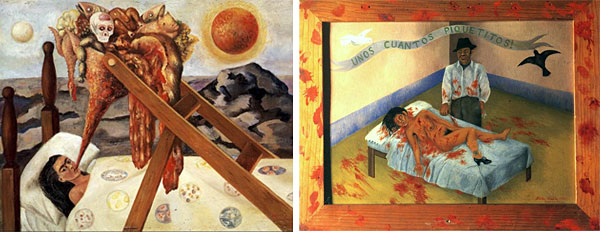
It’s the narrative of Frida’s physically painful life that draws us in and makes us empathize. We may also admire her courage to expose her sorrows so frankly.
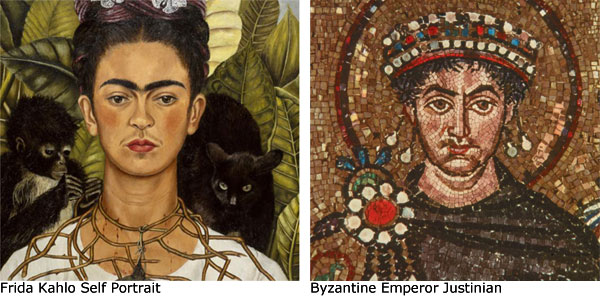
Looking at Frida’s work, I was reminded of Byzantine icons… stiff, often formally symmetrical and symbolic. There’s a lot of “church” in her paintings… pre-Renaissance church, Mexicanized Catholic church. Diego’s work is often churchy, too, but differently. He is a moralist, depicting his peasant players as actors in socialistic “bible stories”.
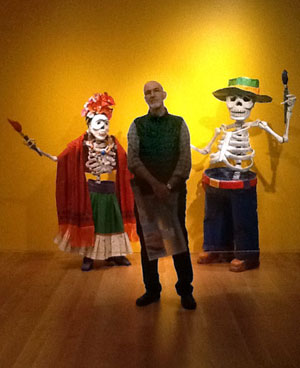 Good remarks by Bill Byres, seen here with the Shadowland parade figures:
“Nourishing”
“My hat is harder to get on… my mind must have expanded.”
Great write up, love the images you posted and would have enjoyed tripping around the show with you & Bill. Next time…..