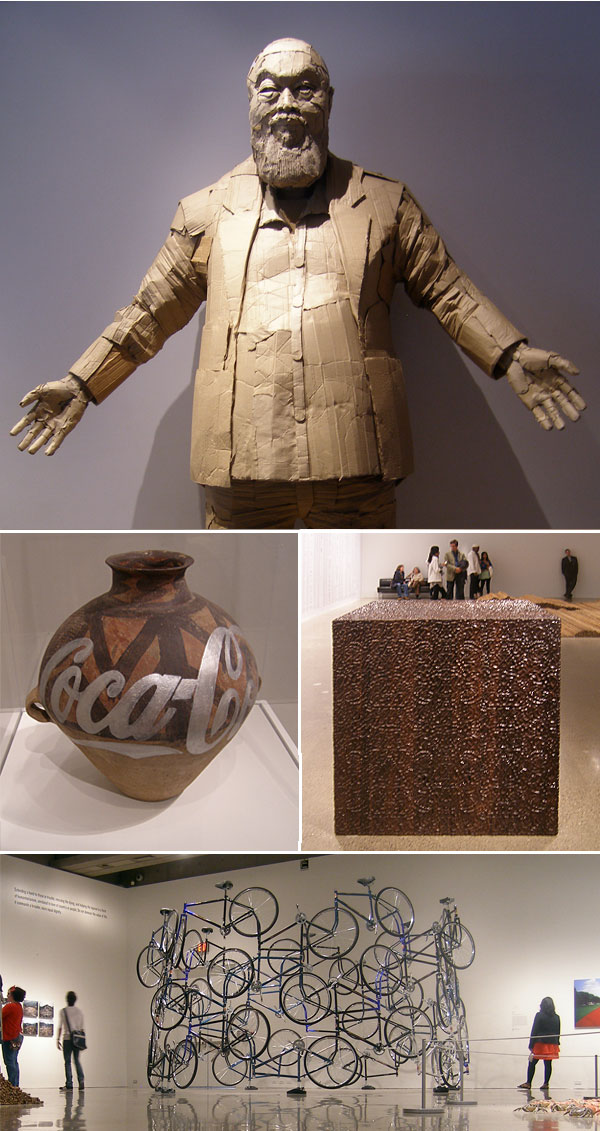
Top: Heroic scale cardboard statue of Ai Weiwei in the AGO lobby, by Canadian artist Sean Martindale. Left: Ai Weiwei exhibits. Neolithlic vase painted with silver Coca-Cola logo. Right: Large rosewood cube, textured with traditional Chinese carving. Bottom: Chinese “Forever” brand bicycles in an eternal circle, without pedals.
A camel, the saying goes, is a horse designed by a committee. Outstanding art-making usually depends on a kind of totalitarianism… one authority making all of the decisions. Workers may assist in production, but they must follow the design dictates of the lead artist. A bit of irony. Ai Weiwei works this way, producing thought-provoking work, superbly crafted. Danica points out that Weiwei’s workers are volunteers who are not imprisoned if they do not want to help on one of his projects. So there’s totalitarianism, and there’s totalitarianism… in this case, one working against the other.
Most of the works in the current show could not have been made by a single artist. They are too big, too heavy and too demanding of specialized skills. Even installing the show must have required armies of helpers and heavy equipment especially the straightened rebar rods. They weigh 38 tonnes.
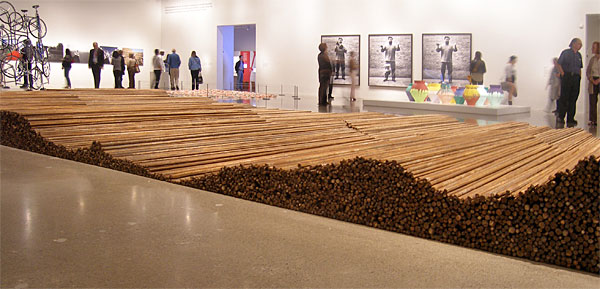
Straightened rebar rods from concrete in earthquake-destroyed school
The rebar was salvaged from the ruins of a school that collapsed in an earthquake, killing over 5,000 students. It was mangled and twisted until Ai Weiwei began to straighten out the record. Substandard construction had contributed to the disaster and officials were keen to suppress evidence of corruption. Even the number of victims was difficult to find out, until Weiwei and his helpers made the count, name by name, and memorialized the students with a wall and audio reading of the list.

Wall of school children’s names.
The Chinese government’s displeasure with Ai Weiwei has led to his present house arrest, of course, while he is the darling of Western governments who are pleased to hold him up in contrast to our our relative freedom of expression. “Everything is art. Everything is politics.” One of many Ai Weiwei quotes imprinted on the gallery walls.
For me, the show is one irony layered upon another. For you, it may be something else… perhaps an awe-inspiring experience of Chinese culture and craftsmanship, or a curiosity about who funds Ai Weiwei’s massive undertakings. One thing is sure, the show will make you think, and think, and think… about art history, aesthetics, politics, freedom, the future of China in the world. Go and enjoy it. Ai Weiwei. According to What? Art Gallery of Ontario until October 27, 2013.
Category: Uncategorized
Ai Weiwei: too much for one blog post
Rather than say what the pieces in the show mean to me, I’m going to record some ideas that went through my head as I looked.
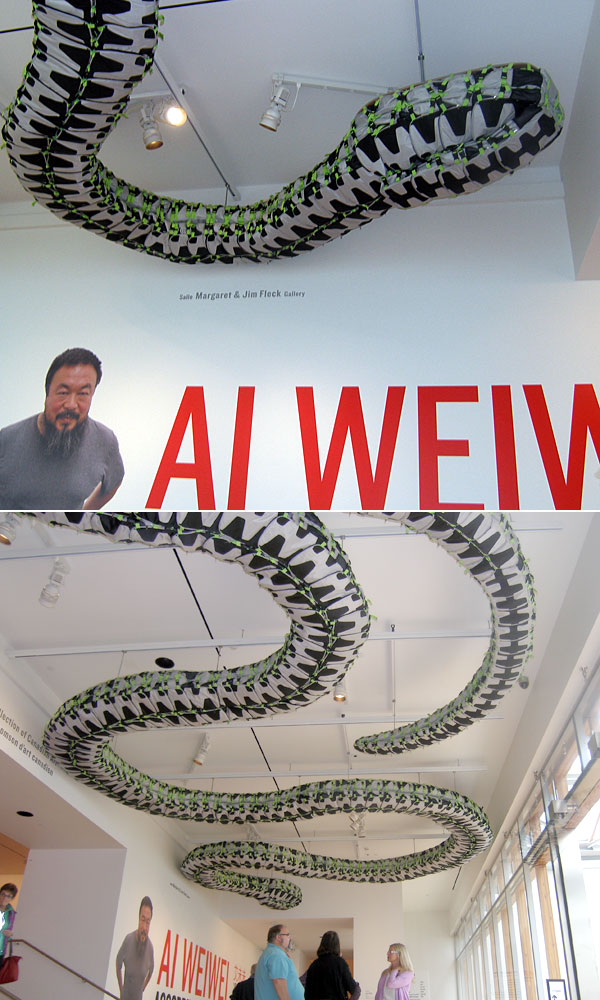
Snake made of school backpacks
Backpacks were strewn all over the disaster site, after the school earthquake collapse. I wonder what the serpent symbolizes in Chinese culture. How clever! How well made! The head is sculpted into shape, as is the tail. Multitudes of people working together. Mass production. Industrialization.
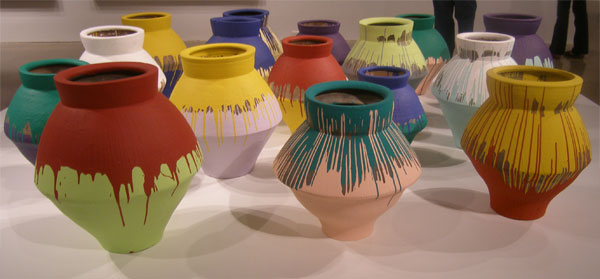
Han dynasty pots dipped in paint
The garish, bright new colours cover old shapes. The old shapes makes the drips and dribbles run the way they do. Sometimes the pots have been turned upside down while the paint dribbled and dried, then turned right side up again. The new and the old. Old defaced. Behind, picture sequence of Ai Weiwei dropping, smashing an ancient pot…and having the act preserved in a photo, framed and shown in a gallery. Preserver/destroyer.
A Faraday cage for cellphones
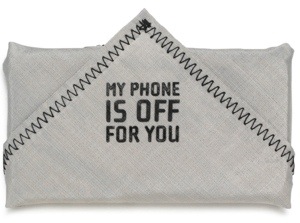
A silver-threaded handerchief is supposed to prevent surveillance of your location if you are carrying a mobile phone. Fifteen bucks plus shipping and tax. Yes, it’s available in Canada… we have our own NSA. It’s called CSEC… same thing.
Authorities are not the only ones scooping your data. Merchants want to pitch you if you are nearby, so cloaking your phone, might prevent nuisance messages. What’s more, the handerchief bears a courtesy message, informing those in your company that you are paying attention to them, not your phone. Nice touch.
Oops. An ominous message appears at the bottom of the ad:
Please note, this item is discontinued. When it sells out, it will no longer be available.
Still covering the news

It’s been a long time since teachers confiscated our Mad Magazines in school. I was never an avid reader, but I admired the illustrations and the irreverance. This month’s cover takes great advantage of the Spy vs Spy series that dates back to the Cold War.
It's not really SquareBob
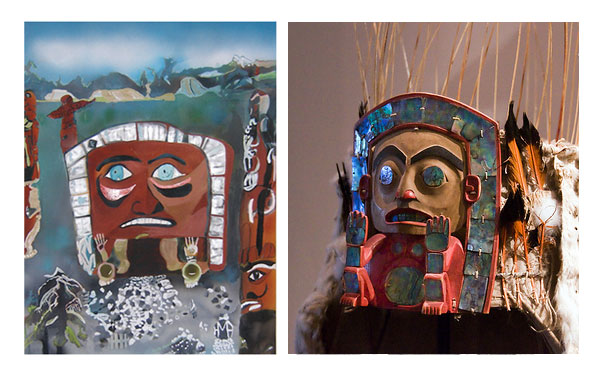
Left: Spirit of Beaver in a Landscape (Tlingit) by Helen Andersen, 1988. Gouache on paper. 21′ x 29.5″
Danica’s impish nickname for this picture is too catchy to let go, so we have taken to calling it SquareBob. Actually, the image derives from the frontlet typically seen on chiefs’ headdresses.
There is a lot going on in Helen’s Myths and Symbols series of paintings and frankly, I find some of the iconography difficult to interpret. This owes, no doubt, to my unfamiliarity with the aboriginal stories that inspired the pictures, but also to the personal and original ways Helen represented some of her ideas. The West Coast landscape, the totem poles and the central Beaver face are obvious enough, but the foreground elements mystify me.
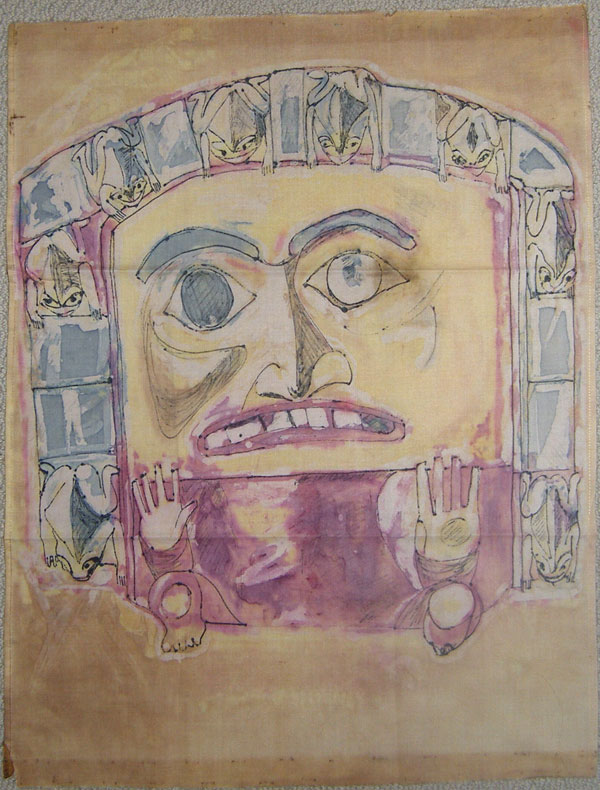
The chief’s frontlet motif held an abiding fascination. Here it is again, this time rendered as a batik. This example was done nearly 2 decades earlier than SpongeBob.
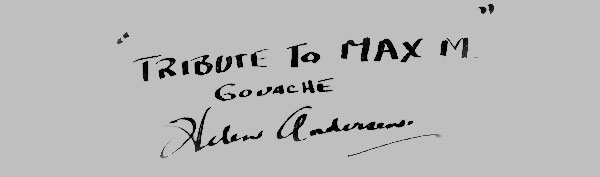
"Tribute to Max M." freshly framed
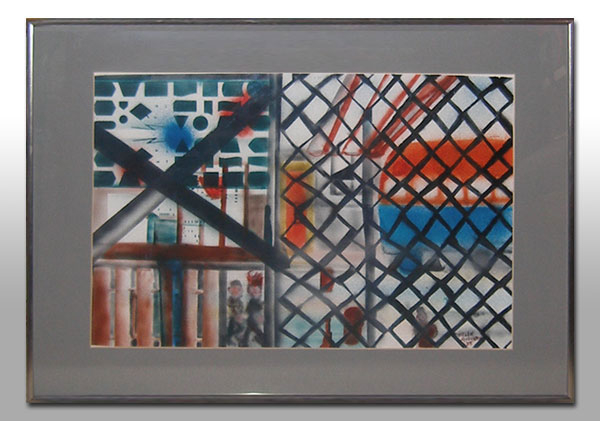 Tribute to Max M. by Helen Andersen. 1985 Gouache on Arches paper
Helen Andersen painted this tribute to Max Maynard some 3 years after the latter’s death. She knew Max well and joined with other friends to help him as much as they could in his last years of failing health. She hints at Max’s troubles in the title, identifying him as the anonymous Max M.
Joni is the Toy Run videographer
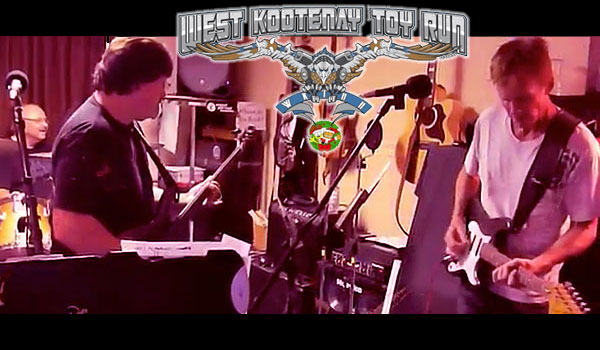
My sister Joni will be in the editing room today, no doubt. Yesterday she was recording the 26th annual West Kootenay Toy Run charity ride. Motorcyclists round up donations and toys to help fill Santa’s sack. I swiped the picture of the band No More Madness from Joni’s sound check video of a practice session.
First framing

When the Indian Children Were Sent Away to the White Man’s School by Helen Andersen. Photo by Thorne Won
It’s appropriate that this is the first of the rediscovered Helen Andersen pieces to be reframed. It is going into the collection of Pat and Dennis Ekland, the couple who found the cache of paintings and brought them to our attention.
We asked Victoria artist Elizabeth Allen to frame the piece professionally as our thank you gift to the Eklands. Pat identified the mother and daughter piece as a personal favourite. Good choice. The theme is a recurrent one in Helen’s work. It was important to her.
Meanwhile, framing activities are beginning in Toronto…

This playful rendering of a toy carousel just needs its glass and it will be ready for the wall. We left the original mat on it because it was in good shape and the colour suits the painting.
I cut my first double mat today, with my new (used) mat cutter… botched it but I learned a lot from my mistakes. The next ones should be perfect.
Make your own YAHOO! logo

Remember that search engine everyone used before Google? No? It was called Yahoo (Yet Another Hierarchical Officious Oracle). Well, Yahoo is trying to recover from its loss of top spot, so the CEO ordered a new logo.
Somebody is lampooning the new look, inviting us to make our own “Yahoo!” logo online. Full disclosure: I did not pay the $500 fee requested for my copy.
Dollarama deals with a TTC dilemma
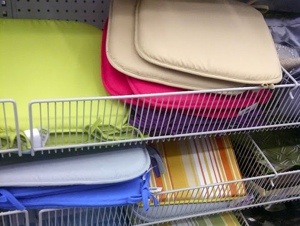 A lady was shopping for something she could put on the seat when she rides on a streetcar, bus or subway. “I’m tired of sitting on the filth,” she said.
I helped her look through the placemats, for something that could be wiped clean pretty easily. One of the mats reminded me of that rubbermat shelf lining that comes in rolls, so we took a look at that, too.
My choice might have been one of the cushions in the photo. Not only a good filth barrier, but a bit of comfort to enhance the flocked steel seats that replace the old upholstered ones.